| Dimensions |
10.2 cm × 27.0 cm × 23.0 cm (4.00 in × 10.63 in × 9.06 in). |
| Weight |
2.3 kg (5.1 lbs) including the gas cylinder. |
| Display |
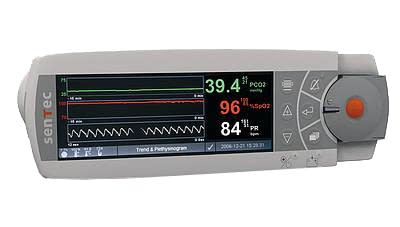
TFT color display with LED backlight. |
| Design |
Features flip feet that act as a carrying handle or adjust the viewing angle for tabletop use. |
| Mounting |
Can be mounted on wall mounts, railings, roll/infusion stands, and transport incubators. |
| Sensors overview |
The SDM uses different sensors to measure a range of parameters. |
| V-Sign™ Sensor (VS-A/P/N) |
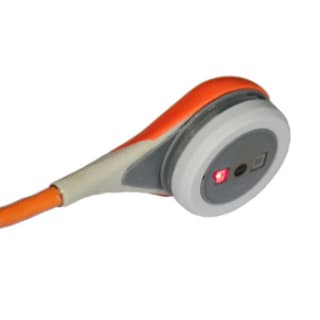
Measures transcutaneous carbon dioxide (tcPCO2), oxygen saturation (SpO2), and pulse rate (PR). In some models, it also provides relative heating power (RHP). |
| OxiVenT™ Sensor (OV-A/P/N) |
Measures transcutaneous carbon dioxide (tcPCO2), transcutaneous oxygen (tcPO2), oxygen saturation (SpO2), and pulse rate (PR). |
| Monitoring modes |
Suitable for a range of patient types, including adult, pediatric, and neonatal. |
| Battery |
Rechargeable, sealed Lithium-Ion battery with a capacity of up to 10 hours. |
| Memory |
Non-volatile FLASH memory can store up to 227 hours of monitoring data at an 8-second resolution. |
| Data recording |
Recording intervals are selectable between 1 and 8 seconds. |
| Serial output |
Includes RS-/EIA-232, supporting protocols such as SenTecLink, Philips VueLink and IntelliBridge, Spacelabs Flexport, Serial Printer, and TCB (TransCutaneous Basic). |
| LAN port |
A LAN port (UDP – RFC 768) is used for remote monitoring with the V-CareNeT™ system. |
| Analog output |
Supports an analog output of 0–1 V. |
| Nurse-call capability |
Has the ability to integrate with a nurse-call system. |
| V-STATS™ software |
Provides fast data download to a PC for analysis and reporting. |
| Alarm system |
Includes both visual and auditory alarms for high and low tcPCO2, tcPO2, SpO2, and PR, as well as technical alarms. |
| Site time |
This timer indicates the remaining time for monitoring at a specific sensor site. Once elapsed, it triggers an alarm and a safety feature reduces the sensor temperature. |
| Site protection |
Reduces the sensor temperature (to 39°C or 41°C) after the Site Time has expired, unless institutional settings dictate otherwise. |
| Sensor temperature |
Sensors operate at a constant temperature to ensure accurate readings. For example, in adults and pediatric patients, the temperature is typically 42°C (if SpO2 is disabled) or 44°C (if SpO2 is enabled). |