

The Spirit Of ‘76 And The Work Of Liberty
Written By Bob Gross
We are in the midst of America’s semiquincentennial anniversary celebration, a time to renew our commitment to the “Spirit of ’76” — the mindset, philosophy, patriotism, and bold action associated with the Founding generation. This spirit propelled the American colonies from protest to revolution, from resistance of British rule to a Declaration of Independence grounded in self-governance, personal freedom, liberty, and equality. It also embraced the radical idea that a diverse group of people could govern themselves without a monarch or imposed rule. In 2026, we are privileged to revisit the Spirit of ’76 and consider how its promise continues to shape America’s moral and civic journey.
1776 was a pivotal year. Rebellion became revolution, and the greatest governing experiment in human history was unleashed. America’s 2026 semiquincentennial celebration of the “Spirit of ’76” is more than an observance of Independence Day; it is a year-long remembrance of the pivotal events and people at America’s founding.
In his July 3, 2026 newsletter, Med One co-founder and board chair, Larry Stevens, shared his thoughts about Independence Day with the Med One team. He noted that it has always been his favorite holiday, one that has grown in importance and significance over a lifetime of service to others and to his country. As he poignantly stated, “I proudly admit that I get a lump in my throat and a tear in my eye every time I sing the National Anthem.” Larry also asked us to consider these words from the Declaration of Independence: We hold these truths to be self-evident, that all men are created equal, that they are endowed by their Creator with certain unalienable rights, that among these are life, liberty, and the pursuit of happiness.
That continuing work is the central meaning of this anniversary: not simply to remember the Declaration as a founding document, but to recognize liberty as an inheritance that must be understood, defended, and renewed by each generation.
America’s 250th anniversary invites us to consider how the Declaration of Independence came about, what it meant at the outset, how its meaning was woven into the U.S. Constitution a decade later, and how it has continued to expand across the nation’s history. The second sentence quoted by Larry has become a kind of american scripture, not because America has always fulfilled it, but because it has continually summoned the nation toward a fuller understanding of liberty and equality.

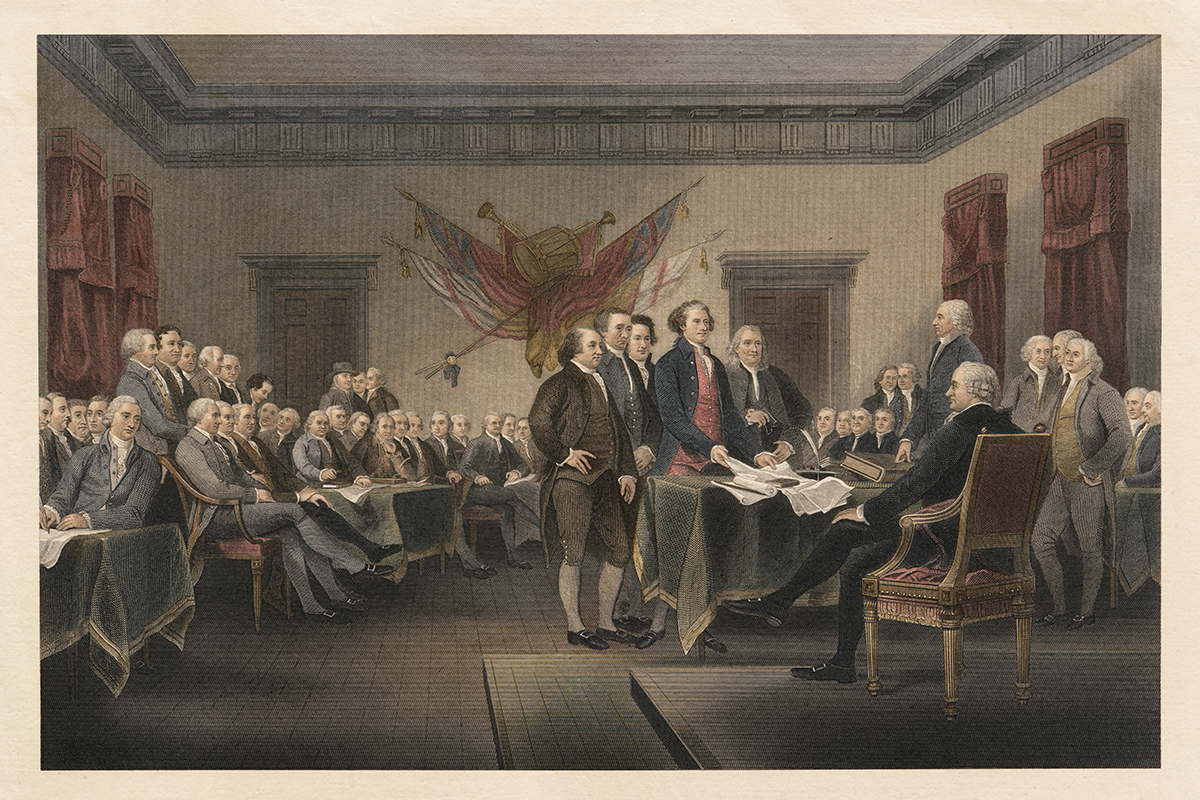
The Declaration of Independence was, in fact, a hasty compilation of justifications for formal separation from Great Britain. In June 1776, after a motion proposing that the thirteen colonies declare independence, sever ties with Great Britain, pursue foreign alliances, and draft a plan of confederation, the Second Continental Congress appointed a Committee of Five to draft a declaration justifying and formalizing independence. Principal among the Committee were Thomas Jefferson, John Adams, and Benjamin Franklin.
Although Jefferson and Adams later remembered the drafting process differently, it is clear that Jefferson became the primary draftsman, with Adams and Franklin serving as editors. Jefferson set about the task in haste. He drew primarily from two source documents: his own draft preamble for a Virginia constitution and a preliminary version of the Virginia Declaration of Rights drafted by George Mason. He labored day and night with quill and ink, focused chiefly on drafting grievances that justified separation from Great Britain. That list of grievances was directed particularly toward King George III, who had recently incensed colonists by refusing to consider Congress’s plea for reconciliation after the Battles of Lexington and Concord, Bunker Hill, and Fort Ticonderoga, and who further outraged them by entering alliances with German states to employ Hessian mercenaries to suppress the rebellious colonies. Jefferson spent little time on the preamble; for that, he incorporated and slightly modified language that he and Mason had already written separately. Jefferson’s preamble reflected European Enlightenment thinking, which had deeply influenced him and other Founders.
The Enlightenment was an intellectual movement of political writers, philosophers, and essayists who elevated reason, individual liberty, and social contract theory over blind faith, exclusive reliance on religious dogma, and absolute royal power. Its core ideas are embedded in the second sentence of the Declaration: that each person is born with equal and inherent rights and the capacity to reason; that people choose to enter societies through social contracts; and that governments are formed by consent of the governed to protect individual rights and promote the common good. Stated another way, each of us has the right and opportunity to seek fulfillment, meaning, and well-being as we personally see fit, free from unnecessary intrusion.
Upon completion of the initial draft, Adams and Franklin suggested only two or three changes to the preamble’s second sentence. The draft was then submitted to Congress, which passionately debated the list of grievances, eliminating many and softening or modifying others. The result was a document that included Jefferson’s preambulatory language, a list of twenty-seven grievances and justifications for separation, and a dramatic pronouncement of independence from Great Britain and the Crown among the “United Colonies of America.”
The Declaration was approved and issued on July 4, with copies dispatched to state leaders and military generals. Although the list of grievances received considerable attention at the time, the preambulatory language did not.
After eight long years of what was largely a war of attrition, the United Colonies prevailed. Congress had adopted the Articles of Confederation to govern during the conclusion and aftermath of the Revolution, but that framework became increasingly inadequate. Delegates from the thirteen states were summoned to Philadelphia in May 1787, ostensibly to “fix” and strengthen the Articles. Upon arrival, many were surprised to find themselves attending a convention in which the Articles were scrapped and the framework for a new governing document was debated over four months. The delegates ultimately reached a compromise government charter and the supreme law of the land: The Constitution of the United States of America. The Constitution reflected Enlightenment principles embedded in the Declaration’s second sentence as the foundation for a system of government that included popular sovereignty, separation of powers among three distinct branches, checks and balances, federalism, and individual rights protected by the Bill of Rights.
The Spirit of ’76 — and indeed the entire Founding Era — has been described by one historian as the “Big Bang” in the American political universe. In a compressed twenty-five-year period in the last quarter of the eighteenth century, America won its independence, announced enlightened values as the foundation of a new republican government, created the first large republic, and established political institutions designed to preserve and protect republican principles. It also helped establish a market-based economic system. Most radically, America shifted worldwide political thought by insisting that political power did not flow from a Creator to monarchs and aristocracies, but instead flowed upward from the people to elected representatives.
Left undone in the Founding Era, however, were a just settlement with Native American peoples and the abolition of slavery. Those failures led to horrific consequences in the nineteenth century: the decimation of Native American communities and the bloodiest war in American history. Over its 250-year history, America has struggled, and continues to struggle, with the contradictions in the Founding Era’s achievements and compromises. Today, some efforts to reinterpret its flaws and contradictions through present-day moral and political standards can oversimplify that history. Historical truth is more complex and more nuanced.
The Founding generation gave the nation its revolutionary language; later generations would be called upon to determine how fully that language would govern American life.
We can thank Lincoln for recasting the second sentence of the Declaration of Independence as an aspirational moral compass and bedrock foundation to guide us forward during one of the most traumatic periods in American history. His evolving moral maturity as a leader became anchored in the conviction that “all men are created equal” meant exactly what it said. He deemed that conviction his “ancient faith,” the “father of all moral principles,” and an “axiom of free society.” In time, Lincoln’s understanding of the purpose and meaning found in the Declaration’s second sentence became the nation’s understanding as well, but that arc of understanding has been long, messy, and often tragic.
In the twentieth century, Martin Luther King captured that understanding in these words: “When the architects of our Republic wrote the magnificent words of the Constitution and the Declaration of Independence, they were signing a promissory note to which every American was to fall heir. This note was a promise that all men — yes, black men as well as white men — would be guaranteed the unalienable rights of life, liberty, and the pursuit of happiness.” He recognized the human contradictions and imperfections of the Founders when he said, “the arc of the moral universe is long, but it bends toward justice.”
Those in my generation have witnessed epochal events along the arc of the moral universe. In our lifetimes, we have seen the phrase “all men” expand to encompass a broader form of Lincoln’s “ancient faith,” including all people regardless of race, national origin, gender, sexual orientation, or personal and spiritual beliefs. We are not, however, done.
Today, as the arc of the moral universe continues to bend toward justice, we do well to remember that it does not bend on its own. Making the phrase “all men are created equal” truly inclusive requires the constant effort of good and decent people.
That is the hope and promise of the Spirit of ’76, yet it requires vigilance and constant care. As Thomas Paine wrote in his 1776 The American Crisis, “those who expect to reap the blessings of freedom must undergo the fatigue of supporting it.” Many are experiencing such fatigue during the current season, especially amid the deep divisions and strains of modern political life.
For me, that truth became more than historical abstraction during a period of public service that brought the meaning of liberty into stark human focus by placing it beside its opposite: a society where freedom had been systematically denied.
Two decades ago, at the request of the White House, I had the opportunity to serve as a senior advisor for the U.S.-led Coalition Provisional Authority in Iraq, the governing entity established after the conclusion of the 2003 ground war that toppled Saddam Hussein. Our role was to advise the temporary Iraqi Governing Council of twenty-five interim Iraqi ministers and leaders, who were appointed to serve until the Coalition transferred full sovereignty to an Iraqi Interim Government in preparation for National Assembly elections. Specifically, I was appointed to advise the temporary Iraqi Minister of Social and Labor Affairs and his deputies. To fulfill that assignment, I quickly assembled a staff of twenty-five civilians and military officers, including representatives from four Coalition partner countries, U.S. military officers, and colleagues from the U.S. Departments of Defense and State.
Our role was advisory at the senior ministry level. We were not frontline military personnel, but we nevertheless served in a theater of war and an active combat zone. Although we were housed and worked in the fortified “Green Zone,” we also had offices at the Ministry compound in the heart of one of Baghdad’s most dangerous areas, where we traveled and worked several days each week. Those daily missions involved transportation to and from the Green Zone on routes that changed daily. We traveled in at least two armored vehicles and were protected by highly trained security from both the U.S. Army and a private South African security team of elite former military and law enforcement personnel. The missions were extraordinarily dangerous and became increasingly so. Our team lost two staff members and the head of our South African security team to ambushes.
Ours, however, was not the day-to-day combat experience of the brave men and women of the U.S. armed forces, who’s day in and day out faced the threats of improvised explosive devices, armed insurgents, suicide bombers, and terrorists from two insurgencies: Al Qaeda of Iraq, which later rebranded as ISIS, and the Shi’a Mahdi Army militia supported by Iran. Those insurgencies erupted shortly after my arrival in Baghdad and grew steadily during my six-month tenure and beyond.
My role gave me both a broad and unique overview of Iraq’s economics, politics, and government. I visited mass gravesites holding the still fully clothed bodies of men, women, and children who had been killed by nerve agents and poison gas. I saw firsthand the dreadful aftermath of more than thirty years of totalitarian rule. I observed how individuals can be deprived of their liberties and how a society’s right to determine its government can be extinguished by systematic oppression. I saw a society governed by law imposed by a regime that served only its own appetite for control and wealth, depriving Iraqis of free expression, speech, and individual liberty. I saw how a city’s power, water, and sewage infrastructure could be degraded over three decades of neglect while resources were used instead to build forty-seven palaces, residences for the ruling elite, and a combined military and security organization intended to control society and threaten neighboring nations. I saw an economy so tightly controlled and manipulated that the collective and individual will to work had been diminished by a government that created state-owned enterprises producing no meaningful goods and providing only meager wages and deficient medical care. I saw how a government built to oppress and control can rob its people of hope.
That perspective made the Memorial more than a monument; it became a visible reminder of the price paid by those who gave practical meaning to the ideals proclaimed in 1776. That lesson came into fullest focus for me near the end of my service.
Toward the end of my tenure, I was summoned back to Washington, D.C., for a weekend to deliver a Monday-morning speech at the Reagan Trade Center. On Saturday, I was invited to a preview tour of the new World War II Memorial on the National Mall, one week before its scheduled opening to the public. I joined surviving World War II veterans and their families on the tour. The experience was overpowering. For more than half of my two-and-a-half-hour visit, tears streamed down my cheeks as I looked into the faces of members of the Greatest Generation and thought about all they had done in the name of liberty and freedom. Six weeks later, I returned to Washington at the end of my deployment. As I exited the airport to catch a cab to my hotel, I was overcome by all I had witnessed during my six months in Baghdad, by my visit to the Memorial, and by overwhelming gratitude and love for my country. Without thinking, I instinctively dropped to my knees and kissed the sidewalk, much, I am sure, to the bewilderment and amusement of those nearby.
That moment became my own enduring connection with the Spirit of ’76 — a reminder that liberty is not secured by memory alone, nor preserved in parchment alone, but sustained across generations by sacrifice, gratitude, moral courage, and the daily duty of free people to keep faith with America’s highest ideals.